Finviz is the screener most active traders open first. It is fast, the free version is genuinely useful, and Elite adds real-time data for less than a charting platform costs. None of that is in dispute here.
The question this post answers is narrower. If you have outgrown the free version and you are looking at the Elite subscription, what are you actually buying, and where does it still stop short? Below is the honest version of both, checked against Finviz’s own pricing and help pages in September 2026 and re-checked on 24 September 2026, and then where NineThirty is built differently.
What Finviz Elite Gives You in 2026
Start with the part most comparison articles skip. Finviz has a free version, and it is not a crippled demo. The free screener covers the US market with delayed quotes, around 50 saved presets, and no alerts.
Elite is the paid tier. It adds real-time quotes and intraday charts, including premarket from 4:00 AM and aftermarket to 8:00 PM Eastern, either side of the NYSE core session. It raises saved presets from 50 to 200. It adds more than 20 advanced, customizable filters on top of the free set. It turns on unlimited email alerts and push notifications for price, insider activity, analyst ratings, news and SEC filings. It removes the ads. Elite used to include a backtester too, but Finviz ended it on 26 March 2026.
There is a 7-day free trial.
How Much Does Finviz Elite Cost in 2026?
Finviz Elite is $39.50 a month, or $299.50 a year. Paying yearly brings the effective rate to about $24.96 a month, so the annual commitment saves roughly a third.
For real-time US market data with a screener attached, that is a fair price. The comparison worth having is not about the number. It is about what the screener can express once you are inside it.
Where Finviz Elite Is Hard to Beat
We should be specific about this, because a comparison that only lists a competitor’s gaps is not a comparison.
Speed. Screens return fast and pages load fast. Finviz has been optimized for a decade and it shows.
The free tier. Very few tools give away that much market coverage.
The maps. The sector heatmap is the most recognizable view in retail trading for a reason.
The calendar. Finviz runs an economic calendar with impact ratings, an earnings calendar with EPS estimates, actuals, surprises and the one-day price reaction after each release, and a dividends calendar with ex-dates, payouts and yields. It is a real feature set.
Earnings timing. The screener has an Earnings Date filter, plus Earnings Before and Earnings After signals. Any comparison telling you Finviz cannot handle earnings timing is wrong.
Insider tracking. There is a standalone SEC Form 4 tracker you can filter by transaction type.
Asset classes. Finviz also carries futures, forex and crypto pages. NineThirty does not.
Where Finviz Elite Runs Out of Room
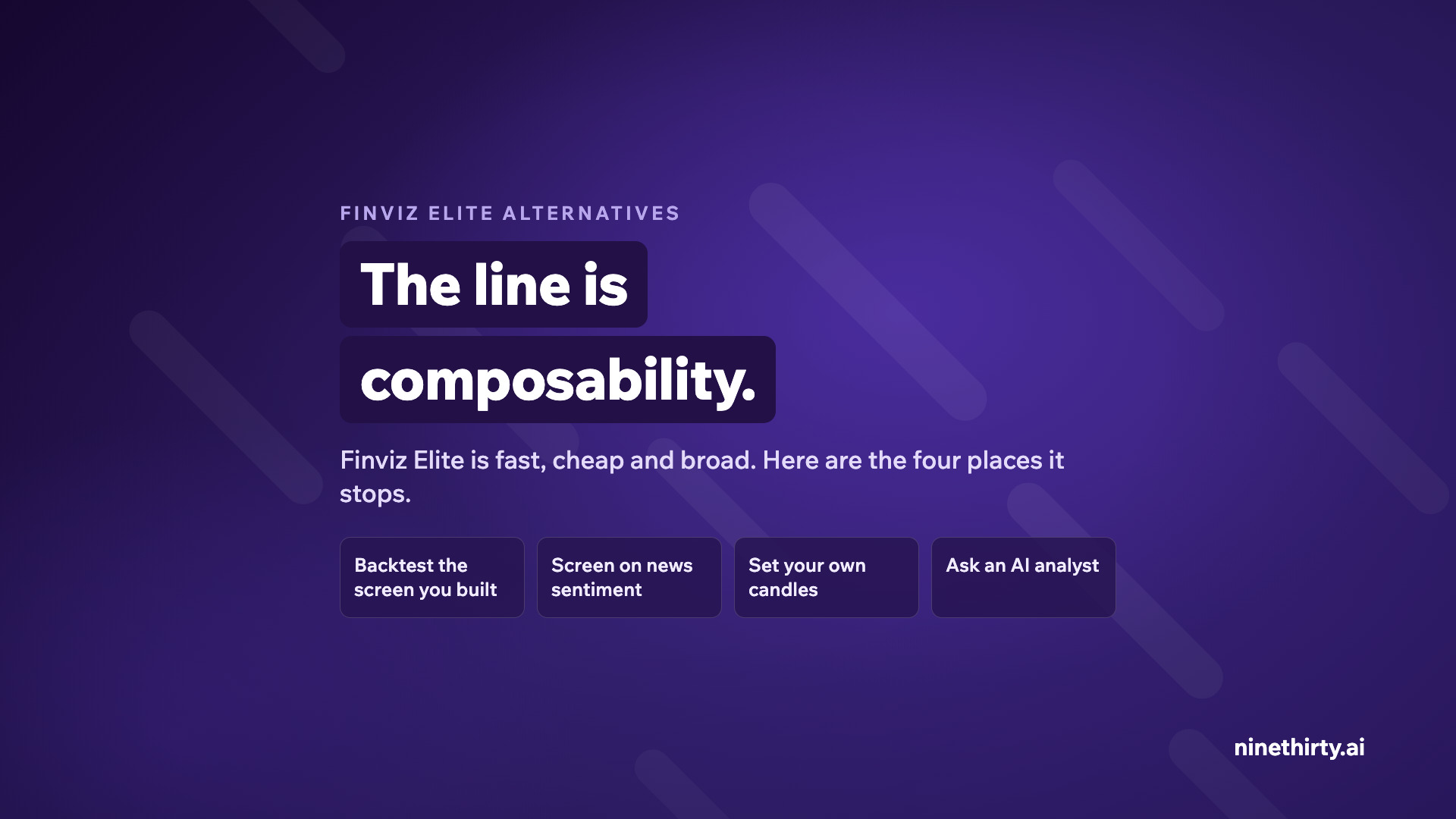
Four gaps. One is a feature Finviz removed this year. The other three are about composability rather than coverage.
Can You Backtest the Screen You Built?
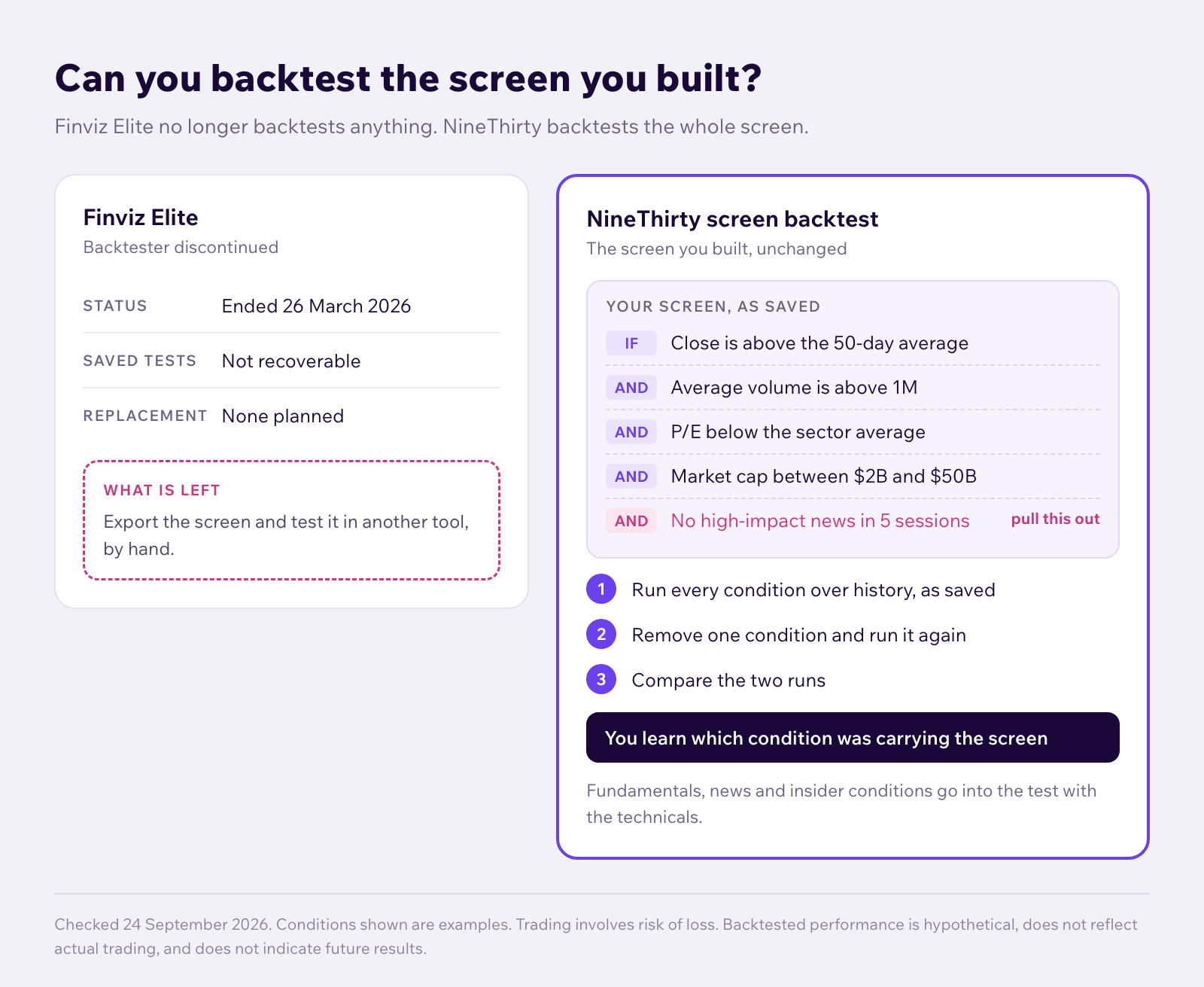
Not in Finviz. Finviz ended its backtester on 26 March 2026. Its backtest page says saved backtests are not recoverable and no replacement is planned. Many comparison articles still list a Finviz backtester. It is gone.
So there is no way inside Finviz to test how a screen performed. Your real screen is not one indicator. It has a liquidity floor, a valuation control against the sector, a market-cap band and a news filter sitting alongside the technical trigger. To test that combination, or to find which of those conditions was doing the work, you export the list and test it in another tool.
The NineThirty screener backtests the screen itself. The same conditions, the same universe, run over history, so you can pull one filter out and see what changes.
Trading involves risk of loss. Backtested performance is hypothetical, does not reflect actual trading, and does not indicate future results.
Can You Screen on News Sentiment?
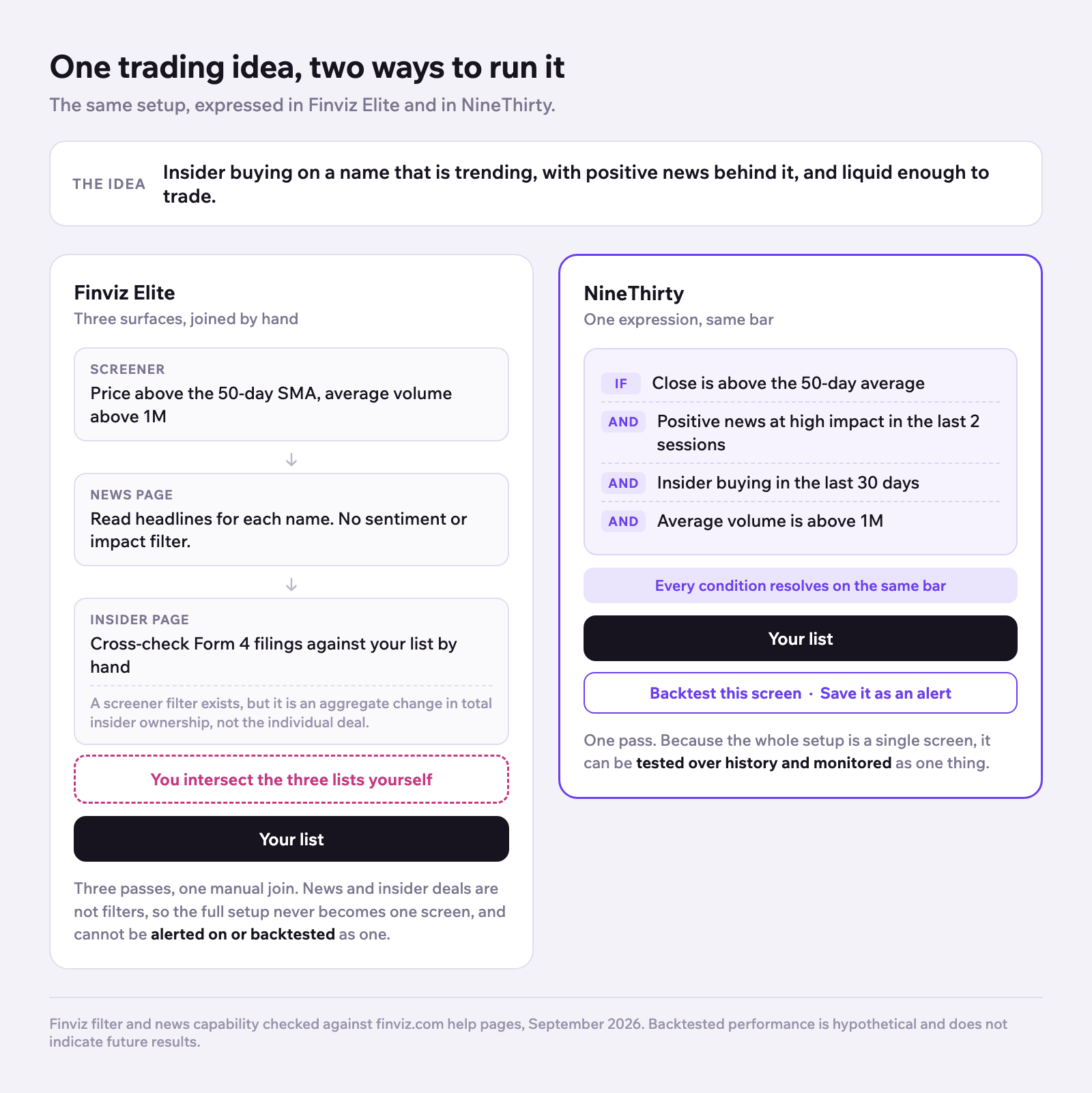
No. Finviz has a strong news page and a Major News signal that surfaces the stocks with the heaviest coverage today. What it does not have is news as a filter that joins the rest of your logic. You cannot ask for positive sentiment, high impact, inside the last two sessions, on a name that is also holding its 50-day average.
NineThirty treats news as a screenable condition, filtered by category, sentiment and impact, nesting with technical and fundamental conditions through AND and OR. Everything resolves on the same bar.
Insider data has the same shape of gap. Finviz gives you an insider page and two ownership filters, where Insider Transactions is the percentage change in total insider ownership. That is an aggregate. It is not the individual deal, and it does not compose with a technical trigger.
The difference shows up in what a screen can be named. Insider Cluster Buying, Insider Gap Up, Negative News Reaction and News Gap are pre-built NineThirty screens, and each one is a single expression that joins a deal or a headline to a price condition. In Finviz those are two separate pages and a manual cross-check.
Can You Set Your Own Candles and Indicator Periods?
No. The screener’s technical filters resolve on periods Finviz has fixed: RSI on 14, simple moving averages at 20, 50 and 200 days, ATR on 14, highs and lows at 20 days, 50 days and 52 weeks.
This is not a claim that Finviz cannot see intraday. Elite gives you real-time data and intraday charts. The point is narrower and it matters more: you cannot define your own candle and screen on it, and you cannot change an indicator’s period. You choose from the list Finviz wrote.
NineThirty lets you define the candle from minutes upward and set the parameters on 40+ technical indicators yourself, then screen and chart on what you defined. Custom interval candles are an Alpha feature and are not in the free tier.
Is There an AI Layer?
No. Finviz is a manual tool, and it is a good one.
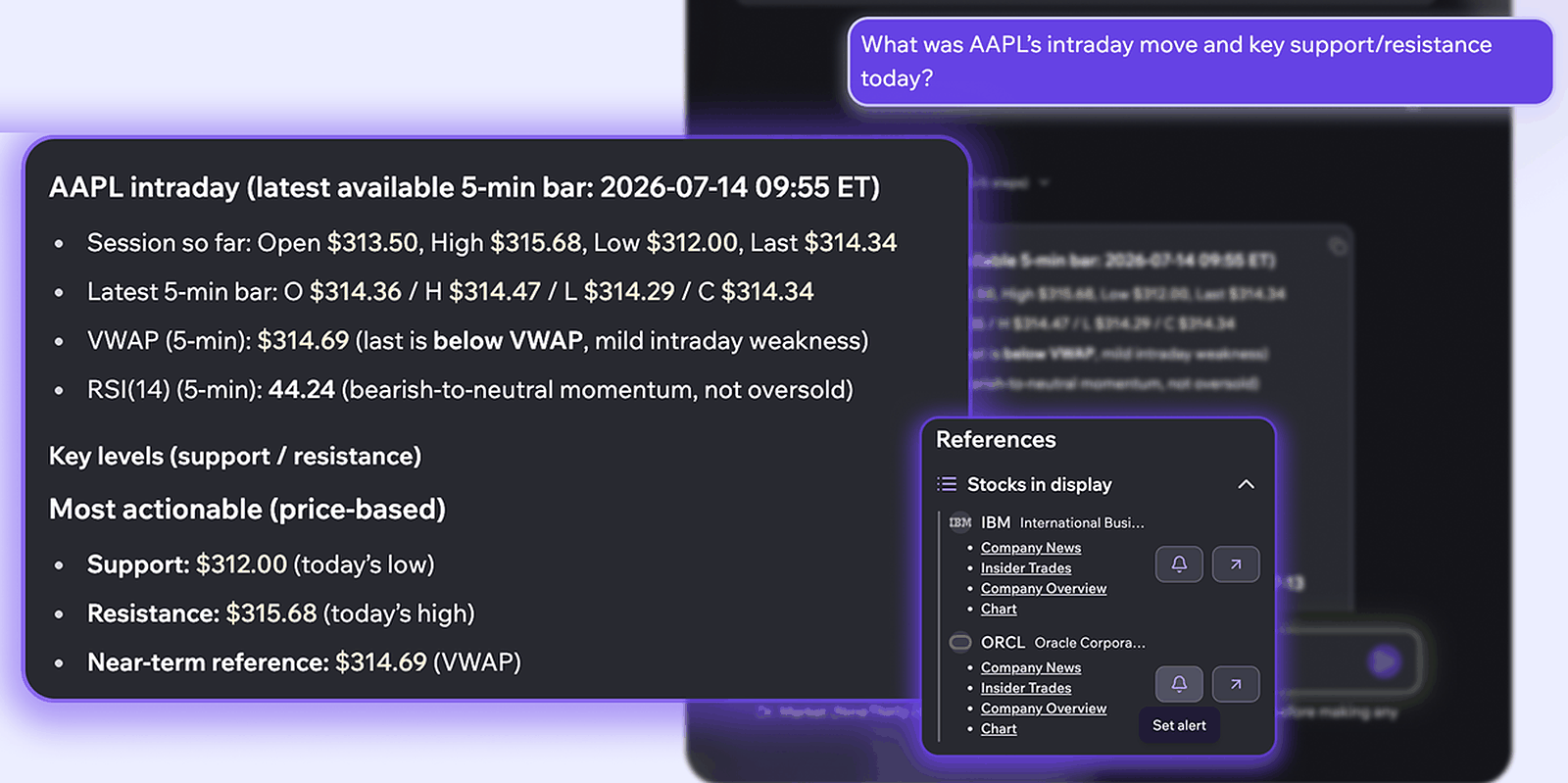
NineThirty ships Dr. Market, a multi-agent analyst that runs on our own data layer rather than on a chat model’s recall. It has no web search and no memory to fall back on. Pricing, fundamentals, news, filings, corporate events, sector data and seasonality are handed to it by feeds built for each job, and every figure it returns links back to the screen, company page, chart, financial statement or news item it came from. If a number is not in the data, Dr. Market does not have it.
The screener also takes plain English. You describe a setup and it builds the filter logic across the indicators, fundamentals, news conditions, corporate actions and insider deals.
NineThirty vs. Finviz Elite: Side-by-Side
| NineThirty Alpha | Finviz Elite |
|---|
| Price | $19.99 a month | $39.50 a month, or $299.50 a year |
| Free tier | Yes | Yes |
| Real-time data | Yes | Yes |
| Backtesting | Yes, backtests the screen you built | No, discontinued 26 March 2026 |
| Plain-English screen building | Yes | No |
| AI analyst with linked sources | Yes, Dr. Market | No |
| Screen on news sentiment and impact | Yes | No, news page and a Major News signal |
| Screen on individual insider deals | Yes | Aggregate ownership change only |
| Custom candle intervals for screening | Yes, hourly and minutes | No, fixed periods |
| Configurable indicator parameters | Yes, across 40+ indicators | No, fixed at RSI 14 and SMA 20, 50, 200 |
| Events calendar | Yes, with returns before and after the announcement | Yes, with the one-day reaction after earnings |
| Active alerts | 50 | Unlimited |
| Futures, forex and crypto | No | Yes |
| Coverage | US equities and ETFs on NYSE and Nasdaq | US equities and ETFs, plus other asset classes |
How Much Does NineThirty Cost?
Basic is free. Alpha is $19.99 a month, an introductory rate against a $99.99 list price, billed monthly. Alpha is the only paid tier, so there is no ladder of plans to work out.
The free tier is a real tier, not a trial. It holds back volume rather than capability: Dr. Market is capped at five messages a day, you get one saved screen, two backtest runs a day, 50 candles of history, one active alert, one candlestick pattern, and no custom interval candles.
Alpha lifts those caps. Unlimited Dr. Market, unlimited saved screens, unlimited backtest runs, 500 candles of history, 50 active alerts, hourly and minute candles, every candlestick pattern, and news screening down to the hour.
Who Should Stay With Finviz Elite
Stay with Finviz if the screener is a starting point rather than the whole process, and the work happens somewhere else afterwards. Stay if you trade futures, forex or crypto alongside equities, because NineThirty does not cover them. Stay if the heatmap and the news page are the reason you open it. Stay if you want unlimited alerts on price and filings and nothing more complicated than that.
Finviz is fast, cheap and broad. If none of the four gaps above describe a problem you actually have, the $39.50 is doing its job.
Who Should Try NineThirty as a Finviz Alternative
Try NineThirty if you have hit one of those four walls.
If you have ever wanted to know which condition in your screen was carrying it, that is the screen backtest. If you keep exporting a Finviz list and then cross-checking headlines by hand, that is news as a screenable condition. If your setup lives on a 15-minute candle or an RSI period you chose yourself, that is custom candles and configurable indicators. If you want to ask a question in a sentence and get an answer with the source attached, that is Dr. Market.
Start on the free tier. Build one screen you already trust, backtest it, then pull out a filter and run it again. You will learn more from that one exercise than from any comparison table, this one included.
The Bottom Line
Finviz Elite is not overpriced. At $39.50 a month it does what it has always done, quickly and cheaply, and it does several things NineThirty does not.
The line between them is composability. Finviz gives you excellent siloed tools: a screener here, a news page there, a calendar, an insider tracker. NineThirty is built so those become conditions in one expression, and so the expression itself can be tested over history.
If your process fits inside one silo at a time, Finviz is the better buy. If your thesis needs three of them joined on the same bar, that is the gap NineThirty was built for.
DISCLAIMER: This article is for educational and informational purposes only. It does not constitute investment advice or a research report.